


Solar Images Friday, 4 October 2002
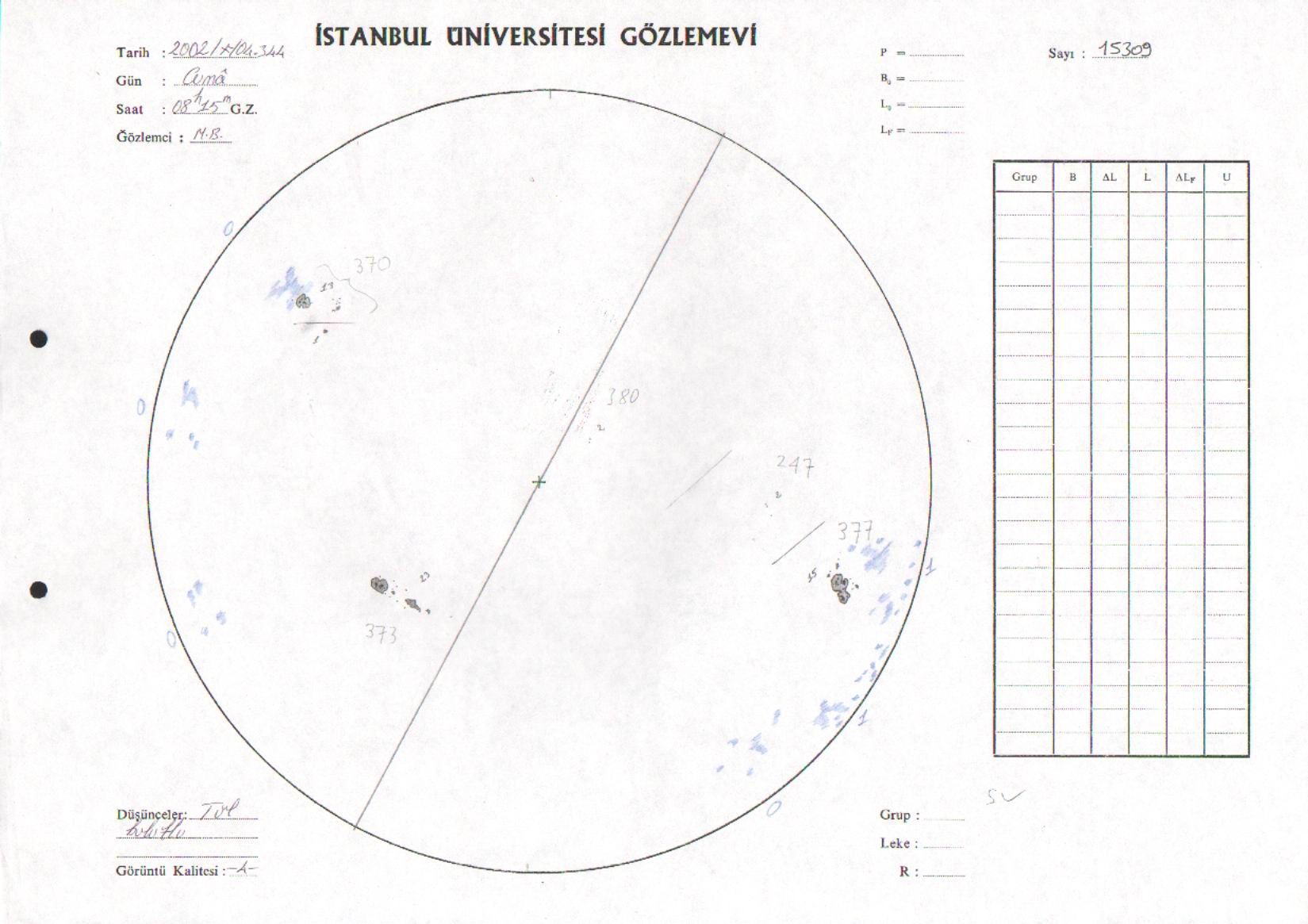
‹ 03.10.2002 2002 05.10.2002 ›Photosphere sunspot drawing and RDS evaluation
Chromosphere (H-α) FITS frames
No chromosphere observation for this day.
Coronado H-α animations from frame sequences
No Coronado observation for this day.
On the Sun this day from the NOAA/SWPC event lists
| Time (UT) | Event | Region |
|---|---|---|
| 00:39–00:53 | M1.0 | 10137 |
| 01:51–01:57 | C7.0 | – |
| 04:17–04:55 | C4.1 | 10137 |
| 04:57–05:03 | C5.3 | – |
| 05:34–05:41 | M4.0 | 10137 |
| 05:36–06:06 | H-α 1N ERU · S19W09 | 10137 |
| 08:42–08:48 | C2.0 | 10139 |
| 08:56–09:18 | C8.0 | 10137 |
| 10:19–10:46 | C6.2 | 10139 |
| 10:37–11:40 | H-α 1N ERU · S20W10 | 10137 |
| 10:54–11:09 | M3.5 | 10137 |
| 12:00–12:07 | C3.2 | – |
| 12:43–13:07 | M1.2 | 10139 |
| 12:45–13:13 | H-α 1F ERU · N08E49 | 10139 |
| 12:57–12:59 | radio type II/1 · shock ~357 km/s | 10139 |
| 15:49–16:01 | C9.0 | 10137 |
| 17:04–17:15 | M1.2 | 10137 |
| 19:07–19:21 | C5.7 | 10139 |
| 19:56–20:22 | C4.8 | 10139 |
| 20:52–21:04 | C4.5 | – |
| 22:32–22:51 | M2.7 | 10139 |
| 22:44–23:06 | radio type II/2 · shock ~418 km/s | 10139 |
| 23:32–23:40 | C6.2 | 10137 |
X-ray flares from the GOES satellites (C, M, X); H-α flares from ground stations (importance: S small, 1–4 larger; F/N/B faint/normal/brilliant; small S flares are listed only if they happened during our observation). A type II radio burst shows a shock wave (usually a coronal mass ejection). Chart: GOES X-ray flux (blue line; every peak is a flare, the letters on the right mark the classes); yellow strips are our chromosphere and blue strips our Coronado observing times.